Sustainability: The Numbers Behind Our Environmental Impact
We don't just claim to be green — we measure it. Here is a transparent look at our carbon footprint, lifecycle data, and the practices that make reclaimed lumber one of the most sustainable building materials available.
Request a Free Quote
Fill out the form below and our team will get back to you within one business day.
Net Carbon Impact: −3,325 Tons CO₂e Annually
Our operations are carbon-negative by a wide margin. For every ton of CO₂e we emit through transportation and facility operations, we offset approximately 14 tons through wood reclamation, landfill diversion, and avoided harvesting.
Carbon Offsets (What We Prevent)
Carbon Emissions (What We Produce)
Net Annual Carbon Impact
Equivalent to taking approximately 720 passenger vehicles off the road for one year, or the carbon sequestered by 3,900 acres of mature forest.
Reclaimed vs. Virgin Lumber: Side by Side
A full lifecycle analysis comparing reclaimed lumber (from demolition to resale) with newly harvested virgin lumber (from forest to mill to retail). Data based on EPA WARM model estimates, USDA Forest Products Laboratory research, and our own operational measurements.
| Environmental Metric | Reclaimed Lumber | Virgin Lumber | Savings |
|---|---|---|---|
| Carbon Emissions (per 1,000 BF) | ~120 lbs CO₂e | ~1,450 lbs CO₂e | 92% reduction |
| Water Consumption (per 1,000 BF) | ~80 gallons | ~5,400 gallons | 98% reduction |
| Energy Use (per 1,000 BF) | ~1.2M BTU | ~6.9M BTU | 83% reduction |
| Landfill Waste Generated | <1% of input | ~15% of harvest | 99% reduction |
| Habitat Disruption | Zero | ~0.6 acres per 1,000 BF | 100% reduction |
| Old-Growth Timber Demand | Zero (preserves existing) | Contributes to depletion | Total elimination |
Data sources: EPA WARM Model v16, USDA Forest Products Laboratory General Technical Report FPL-GTR-199, Athena Sustainable Materials Institute LCI Database, and Lumber New Orleans internal operations data (2024-2026). All figures are estimates based on industry-standard methodologies and may vary based on species, transportation distance, and processing requirements.
What 500,000 Board Feet of Reclamation Looks Like
How We Minimize Our Footprint at Every Step
Sustainability is not a department — it is embedded in every operational decision we make, from how we heat our kilns to how we route our trucks.
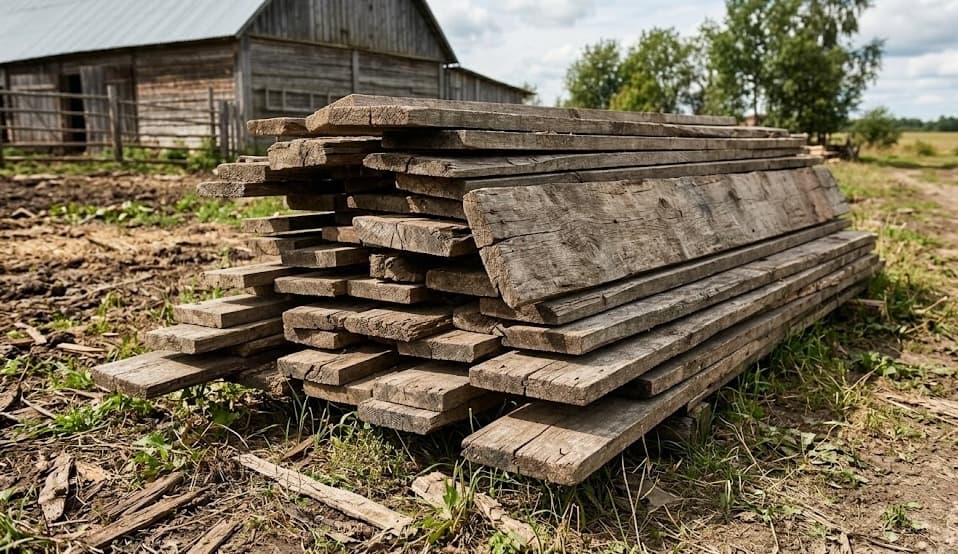
Giving every board a second life
Reclaimed lumber sourced from historic structures and rural barns across the Gulf South
Solar-Assisted Kiln Drying
Our drying kilns are supplemented by solar thermal panels that pre-heat intake air. During Louisiana's long summers, solar energy provides up to 60% of the heat needed for kiln drying. This dramatically reduces our natural gas consumption compared to conventional kiln operations and cuts drying-related emissions by over half.
Closed-Loop Water Management
The small amount of water used in our dust suppression and cleaning systems is captured, filtered, and recirculated. Rainwater collected from our warehouse roof supplements the system. We discharge zero process water to municipal drains. Annual municipal water consumption at our facility is under 15,000 gallons — roughly equivalent to a single-family home.
De-Nailing Metal Recycling
Every board we process yields nails, screws, bolts, and other metal fasteners. Rather than discard these, we sort them by metal type — ferrous and non-ferrous — and sell them to local scrap recyclers. In a typical year, we recover over 4 tons of metal that would otherwise end up in landfills alongside the wood it was embedded in.
Sawdust & Offcut Diversion
Planing and milling operations generate significant volumes of sawdust and shavings. None of it goes to waste. Clean sawdust is sold to local farms for animal bedding and composting. Offcuts too small for resale are bundled as kindling or donated to community woodworking programs. Our diversion rate for wood byproducts is 100%.
Route-Optimized Logistics
Our delivery and pickup routes are planned to minimize empty miles. When a truck delivers lumber to a job site, we schedule a pickup from a nearby demolition or salvage site on the return trip. This practice reduces our per-board-foot transportation emissions by approximately 35% compared to single-purpose trips.
Low-VOC Processing
We do not apply chemical treatments, stains, or sealants to our reclaimed lumber unless specifically requested by the customer. When finishing is requested, we use only low-VOC, water-based products that meet or exceed CARB Phase II and EPA TSCA Title VI emissions standards. Our processing facility air quality consistently tests below OSHA permissible exposure limits.
Verified Practices, Trusted Partners
We hold ourselves to third-party standards and partner with organizations that share our commitment to environmental responsibility.
USGBC & LEED Compliance
Our reclaimed lumber qualifies for LEED credits under MR Credit 3 (Materials Reuse) and MR Credit 5 (Regional Materials). We provide documentation packages to help architects and builders earn these points on certified green building projects.
EPA WARM Model Verified
We use the EPA's Waste Reduction Model (WARM) to calculate the greenhouse gas emissions impact of our operations. Our carbon accounting follows EPA-approved methodologies, ensuring our environmental claims are grounded in federal standards.
Louisiana Environmental Action Network
We partner with LEAN on community outreach programs that educate homeowners and contractors about sustainable building practices. Together, we advocate for state-level policies that incentivize construction waste diversion.
Reclaimed Wood Council
As members of the Reclaimed Wood Council, we adhere to industry best practices for grading, processing, and marketing reclaimed lumber. This ensures our customers receive material that meets nationally recognized quality standards.
Gulf South Green Building Alliance
We collaborate with the regional green building alliance to train contractors on specifying and installing reclaimed materials. Our yard hosts quarterly workshops on sustainable construction techniques.
Zero Waste Business Pledge
We have signed the Zero Waste Business Pledge, committing to divert at least 90% of waste from landfills. Our current diversion rate exceeds 99%, well above the pledge threshold.
Why Reclaimed Wood Is a Carbon Solution
Carbon Sequestration in Wood
Wood is approximately 50% carbon by dry weight. A single board foot of lumber contains roughly 2.7 lbs of CO₂ equivalent, locked in during the tree's growth through photosynthesis. As long as the wood remains intact — whether in a building, furniture, or a stack in our yard — that carbon stays sequestered.
When wood is sent to a landfill, it decomposes anaerobically and releases methane (CH₄). Methane has a global warming potential 84 times greater than CO₂ over 20 years. When wood is incinerated, all of its stored carbon is released immediately as CO₂. Reclamation avoids both scenarios entirely.
Avoided Harvesting Impact
Every board foot of reclaimed lumber sold displaces demand for an equivalent amount of virgin timber. The environmental cost of harvesting new lumber is substantial: logging operations require road-building into forest areas, heavy diesel-powered equipment, and long-haul transportation from remote harvest sites to mills.
Beyond carbon, deforestation degrades biodiversity, disrupts watershed hydrology, and reduces the land's capacity to absorb future carbon. By extending the service life of lumber already in circulation, reclamation preserves standing forests and the ecosystem services they provide — including habitat, water filtration, and flood control, all of which are critically important in Louisiana.
Embodied Energy Advantage
The concept of “embodied energy” measures the total energy consumed in producing a material — from extraction through manufacturing. Virgin lumber has significant embodied energy: chainsaw fuel, skidder operations, kiln drying at the mill, planing, and transportation average roughly 6,900 BTU per board foot.
Reclaimed lumber requires only de-nailing, re-drying (if needed), and re-planing — operations that consume approximately 1,200 BTU per board foot. This 83% reduction in embodied energy means that reclaimed lumber delivers equivalent or superior structural performance at a fraction of the environmental cost.
Radical Transparency in Environmental Reporting
We publish these figures not because we are required to, but because we believe that credible environmental claims must be backed by data. Too many companies use “green” and “sustainable” as marketing buzzwords without providing evidence.
We track our carbon footprint quarterly using standardized methodologies. We welcome questions about our data, our methods, and our results. If we fall short in any area, we will report that too — because accountability is what separates genuine sustainability from greenwashing.
If you are an architect, builder, or organization that needs environmental data for LEED documentation, carbon reporting, or sustainability audits, contact us. We provide detailed data packages tailored to your requirements.
Build Sustainably with Reclaimed Lumber
Every board you buy from us is a board that didn't go to a landfill and a tree that stayed standing. Make your next project part of the solution.